
GPS Isn't a Solved Problem—It's One of the World's Hidden Infrastructure Vulnerabilities. What Will It Take for Xona Space Systems to Become Critical Infrastructure?
A BH Weekly Analysis: Why the company with one of the most unique developmental pathways in commercial space is building infrastructure that looks more like SWIFT than satellite services



Join Beyond Horizon for one original intelligence report each week exploring where frontier space companies are heading—and why.
Text-only version:
GPS Isn’t a Solved Problem—It’s One of the World’s Hidden Infrastructure Vulnerabilities. What Will It Take for Xona Space Systems to Become Critical Infrastructure?
A BH Weekly Analysis: Why the company with one of the most unique developmental pathways in commercial space is building infrastructure that looks more like SWIFT than satellite services
Immediate · 0–2y | Horizon · 3–5y | Beyond · 10y+
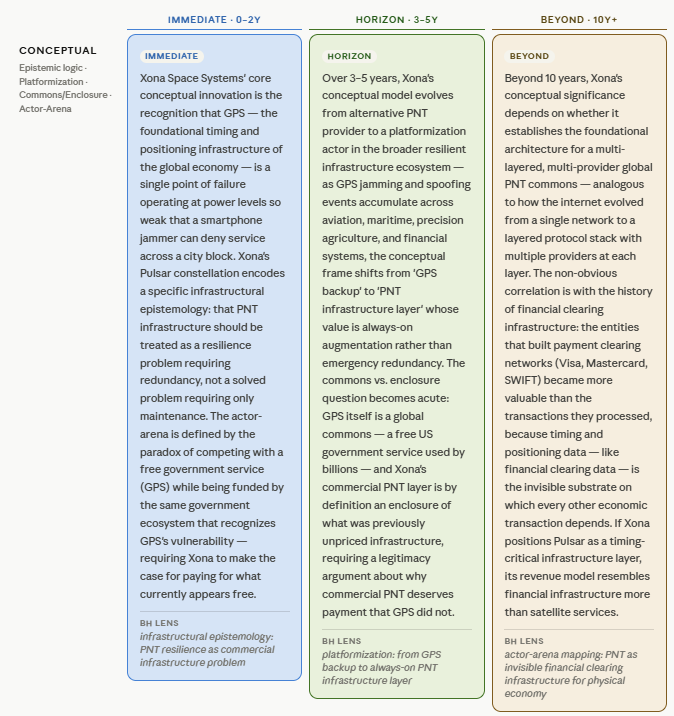
CONCEPTUAL — Epistemic logic · Platformization · Commons/Enclosure · Actor-Arena
Immediate
Xona Space Systems’ core conceptual innovation is the recognition that GPS — the foundational timing and positioning infrastructure of the global economy — is a single point of failure operating at power levels so weak that a smartphone jammer can deny service across a city block. Xona’s Pulsar constellation encodes a specific infrastructural epistemology: that PNT infrastructure should be treated as a resilience problem requiring redundancy, not a solved problem requiring only maintenance. The actor-arena is defined by the paradox of competing with a free government service (GPS) while being funded by the same government ecosystem that recognizes GPS’s vulnerability — requiring Xona to make the case for paying for what currently appears free.
BH lens: infrastructural epistemology — PNT resilience as commercial infrastructure problem
Horizon
Over 3–5 years, Xona’s conceptual model evolves from alternative PNT provider to a platformization actor in the broader resilient infrastructure ecosystem — as GPS jamming and spoofing events accumulate across aviation, maritime, precision agriculture, and financial systems, the conceptual frame shifts from ‘GPS backup’ to ‘PNT infrastructure layer’ whose value is always-on augmentation rather than emergency redundancy. The commons vs. enclosure question becomes acute: GPS itself is a global commons — a free US government service used by billions — and Xona’s commercial PNT layer is by definition an enclosure of what was previously unpriced infrastructure, requiring a legitimacy argument about why commercial PNT deserves payment that GPS did not.
BH lens: platformization — from GPS backup to always-on PNT infrastructure layer
Beyond
Beyond 10 years, Xona’s conceptual significance depends on whether it establishes the foundational architecture for a multi-layered, multi-provider global PNT commons — analogous to how the internet evolved from a single network to a layered protocol stack with multiple providers at each layer. The non-obvious correlation is with the history of financial clearing infrastructure: the entities that built payment clearing networks (Visa, Mastercard, SWIFT) became more valuable than the transactions they processed, because timing and positioning data — like financial clearing data — is the invisible substrate on which every other economic transaction depends. If Xona positions Pulsar as a timing-critical infrastructure layer, its revenue model resembles financial infrastructure more than satellite services.
BH lens: actor-arena mapping — PNT as invisible financial clearing infrastructure for physical economy
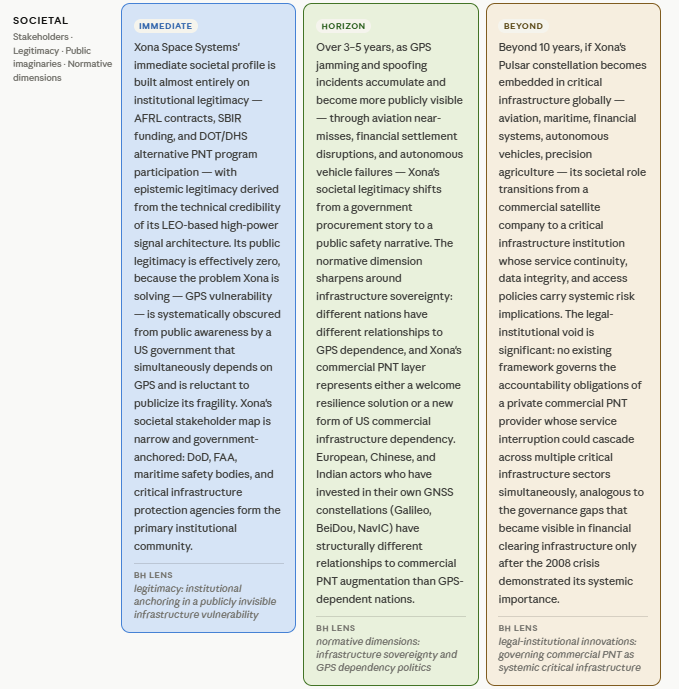
SOCIETAL — Stakeholders · Legitimacy · Public imaginaries · Normative dimensions
Immediate
Xona Space Systems’ immediate societal profile is built almost entirely on institutional legitimacy — AFRL contracts, SBIR funding, and DOT/DHS alternative PNT program participation — with epistemic legitimacy derived from the technical credibility of its LEO-based high-power signal architecture. Its public legitimacy is effectively zero, because the problem Xona is solving — GPS vulnerability — is systematically obscured from public awareness by a US government that simultaneously depends on GPS and is reluctant to publicize its fragility. Xona’s societal stakeholder map is narrow and government-anchored: DoD, FAA, maritime safety bodies, and critical infrastructure protection agencies form the primary institutional community.
BH lens: legitimacy — institutional anchoring in a publicly invisible infrastructure vulnerability
Horizon
Over 3–5 years, as GPS jamming and spoofing incidents accumulate and become more publicly visible — through aviation near-misses, financial settlement disruptions, and autonomous vehicle failures — Xona’s societal legitimacy shifts from a government procurement story to a public safety narrative. The normative dimension sharpens around infrastructure sovereignty: different nations have different relationships to GPS dependence, and Xona’s commercial PNT layer represents either a welcome resilience solution or a new form of US commercial infrastructure dependency. European, Chinese, and Indian actors who have invested in their own GNSS constellations (Galileo, BeiDou, NavIC) have structurally different relationships to commercial PNT augmentation than GPS-dependent nations.
BH lens: normative dimensions — infrastructure sovereignty and GPS dependency politics
Beyond
Beyond 10 years, if Xona’s Pulsar constellation becomes embedded in critical infrastructure globally — aviation, maritime, financial systems, autonomous vehicles, precision agriculture — its societal role transitions from a commercial satellite company to a critical infrastructure institution whose service continuity, data integrity, and access policies carry systemic risk implications. The legal-institutional void is significant: no existing framework governs the accountability obligations of a private commercial PNT provider whose service interruption could cascade across multiple critical infrastructure sectors simultaneously, analogous to the governance gaps that became visible in financial clearing infrastructure only after the 2008 crisis demonstrated its systemic importance.
BH lens: legal-institutional innovations — governing commercial PNT as systemic critical infrastructure
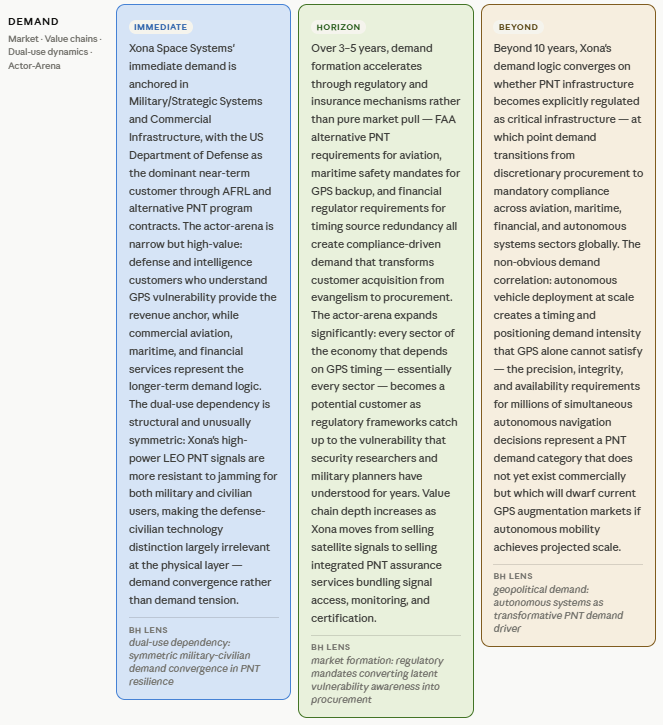
DEMAND — Market · Value chains · Dual-use dynamics · Actor-Arena
Immediate
Xona Space Systems’ immediate demand is anchored in Military/Strategic Systems and Commercial Infrastructure, with the US Department of Defense as the dominant near-term customer through AFRL and alternative PNT program contracts. The actor-arena is narrow but high-value: defense and intelligence customers who understand GPS vulnerability provide the revenue anchor, while commercial aviation, maritime, and financial services represent the longer-term demand logic. The dual-use dependency is structural and unusually symmetric: Xona’s high-power LEO PNT signals are more resistant to jamming for both military and civilian users, making the defense-civilian technology distinction largely irrelevant at the physical layer — demand convergence rather than demand tension.
BH lens: dual-use dependency — symmetric military-civilian demand convergence in PNT resilience
Horizon
Over 3–5 years, demand formation accelerates through regulatory and insurance mechanisms rather than pure market pull — FAA alternative PNT requirements for aviation, maritime safety mandates for GPS backup, and financial regulator requirements for timing source redundancy all create compliance-driven demand that transforms customer acquisition from evangelism to procurement. The actor-arena expands significantly: every sector of the economy that depends on GPS timing — essentially every sector — becomes a potential customer as regulatory frameworks catch up to the vulnerability that security researchers and military planners have understood for years. Value chain depth increases as Xona moves from selling satellite signals to selling integrated PNT assurance services bundling signal access, monitoring, and certification.
BH lens: market formation — regulatory mandates converting latent vulnerability awareness into procurement
Beyond
Beyond 10 years, Xona’s demand logic converges on whether PNT infrastructure becomes explicitly regulated as critical infrastructure — at which point demand transitions from discretionary procurement to mandatory compliance across aviation, maritime, financial, and autonomous systems sectors globally. The non-obvious demand correlation: autonomous vehicle deployment at scale creates a timing and positioning demand intensity that GPS alone cannot satisfy — the precision, integrity, and availability requirements for millions of simultaneous autonomous navigation decisions represent a PNT demand category that does not yet exist commercially but which will dwarf current GPS augmentation markets if autonomous mobility achieves projected scale.
BH lens: geopolitical demand — autonomous systems as transformative PNT demand driver
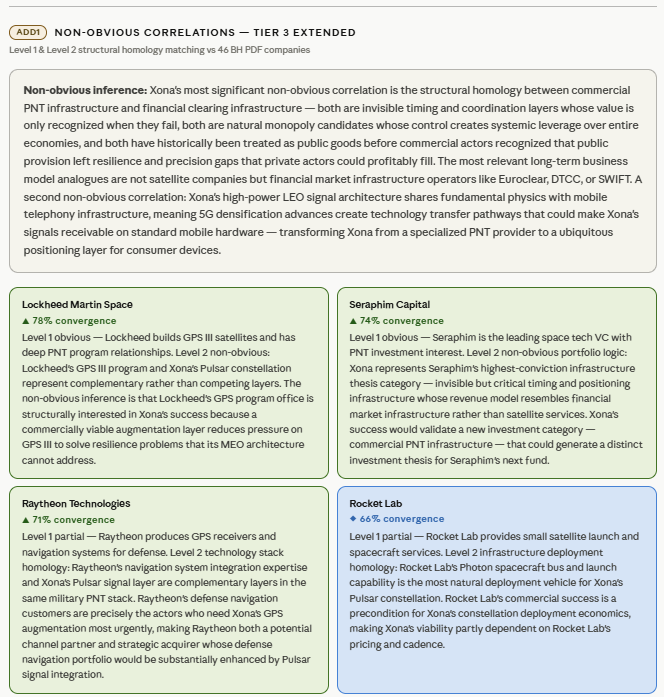
ADD1 — Non-Obvious Correlations — Tier 3 Extended
Level 1 & Level 2 structural homology matching vs 46 BH PDF companies
Non-obvious inference: Xona’s most significant non-obvious correlation is the structural homology between commercial PNT infrastructure and financial clearing infrastructure — both are invisible timing and coordination layers whose value is only recognized when they fail, both are natural monopoly candidates whose control creates systemic leverage over entire economies, and both have historically been treated as public goods before commercial actors recognized that public provision left resilience and precision gaps that private actors could profitably fill. The most relevant long-term business model analogues are not satellite companies but financial market infrastructure operators like Euroclear, DTCC, or SWIFT. A second non-obvious correlation: Xona’s high-power LEO signal architecture shares fundamental physics with mobile telephony infrastructure, meaning 5G densification advances create technology transfer pathways that could make Xona’s signals receivable on standard mobile hardware — transforming Xona from a specialized PNT provider to a ubiquitous positioning layer for consumer devices.
Lockheed Martin Space — ▲ 78% convergence
Level 1 obvious — Lockheed builds GPS III satellites and has deep PNT program relationships. Level 2 non-obvious: Lockheed’s GPS III program and Xona’s Pulsar constellation represent complementary rather than competing layers. The non-obvious inference is that Lockheed’s GPS program office is structurally interested in Xona’s success because a commercially viable augmentation layer reduces pressure on GPS III to solve resilience problems that its MEO architecture cannot address.
Seraphim Capital — ▲ 74% convergence
Level 1 obvious — Seraphim is the leading space tech VC with PNT investment interest. Level 2 non-obvious portfolio logic: Xona represents Seraphim’s highest-conviction infrastructure thesis category — invisible but critical timing and positioning infrastructure whose revenue model resembles financial market infrastructure rather than satellite services. Xona’s success would validate a new investment category — commercial PNT infrastructure — that could generate a distinct investment thesis for Seraphim’s next fund.
Raytheon Technologies — ▲ 71% convergence
Level 1 partial — Raytheon produces GPS receivers and navigation systems for defense. Level 2 technology stack homology: Raytheon’s navigation system integration expertise and Xona’s Pulsar signal layer are complementary layers in the same military PNT stack. Raytheon’s defense navigation customers are precisely the actors who need Xona’s GPS augmentation most urgently, making Raytheon both a potential channel partner and strategic acquirer whose defense navigation portfolio would be substantially enhanced by Pulsar signal integration.
Rocket Lab — ◆ 66% convergence
Level 1 partial — Rocket Lab provides small satellite launch and spacecraft services. Level 2 infrastructure deployment homology: Rocket Lab’s Photon spacecraft bus and launch capability is the most natural deployment vehicle for Xona’s Pulsar constellation. Rocket Lab’s commercial success is a precondition for Xona’s constellation deployment economics, making Xona’s viability partly dependent on Rocket Lab’s pricing and cadence.
LeoLabs — ◆ 62% convergence
Level 1 fails — LeoLabs tracks orbital debris, Xona provides PNT signals. Level 2 precision timing infrastructure homology: LeoLabs’ space situational awareness systems and Xona’s Pulsar constellation both depend on and contribute to precise timing infrastructure. LeoLabs’ debris tracking accuracy is ultimately bounded by the same timing precision limitations that Xona’s Pulsar constellation addresses — making Xona’s PNT infrastructure a potential enabler for next-generation space situational awareness precision.
D-Orbit — ◆ 57% convergence
Level 1 fails — D-Orbit provides orbital transport and disposal. Level 2 LEO infrastructure deployment homology: D-Orbit’s precise orbital insertion capability and Xona’s need for precisely positioned Pulsar constellation satellites create a non-obvious supply chain relationship. Precision orbital positioning is as important to Xona’s signal coverage architecture as signal power — making orbital deployment precision a Xona-specific demand driver for D-Orbit’s services.
Capella Space — ▼ 49% convergence
Level 1 fails — Capella provides SAR Earth observation. Level 2 government contract go-to-market homology: both companies’ primary near-term revenue is classified or sensitive government contracts, and both face the same fundamental challenge — transitioning from government-primary to genuinely diversified commercial revenue. Their strategies for managing this transition will generate useful institutional learning even without any direct commercial relationship.
Isar Aerospace — ▼ 44% convergence
Level 1 fails — Isar is a European launch company. Level 2 sovereign infrastructure homology: Isar’s European launch sovereignty mission and Xona’s US commercial PNT resilience mission both instantiate the same abstract argument — critical infrastructure depending on a single provider requires commercial alternatives for strategic resilience. European customers who understand GPS dependency will also understand European launch dependency, making both natural co-inhabitants of the same sovereign infrastructure conversation.
ADD1 · IPO — IPO Likelihood & Valuation
Structural IPO argument: Xona Space Systems’ IPO logic has no precedent in public space markets: a commercial timing and positioning infrastructure company whose revenue model resembles financial market infrastructure more than satellite services. The most relevant public market comparables are not EO companies or launch providers but financial infrastructure operators — Intercontinental Exchange, Broadridge Financial Solutions, or the London Stock Exchange Group — whose valuations reflect systemic importance and switching costs of timing and coordination infrastructure. The critical variable is demonstrating that regulatory mandates for GPS backup have created compliance-driven recurring revenue from non-defense customers — at that point the valuation framework shifts from ‘defense-dependent space startup’ to ‘critical infrastructure operator with regulatory moat.’
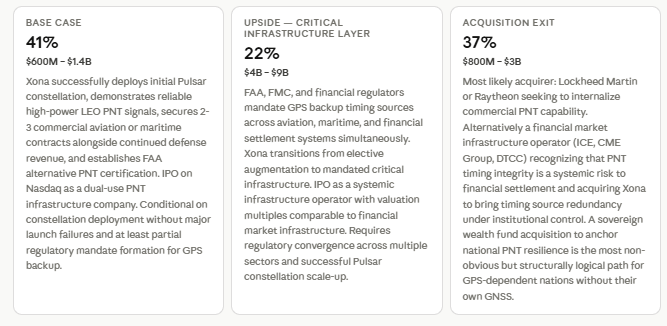
Base Case — 41% — $600M – $1.4B
Xona successfully deploys initial Pulsar constellation, demonstrates reliable high-power LEO PNT signals, secures 2-3 commercial aviation or maritime contracts alongside continued defense revenue, and establishes FAA alternative PNT certification. IPO on Nasdaq as a dual-use PNT infrastructure company. Conditional on constellation deployment without major launch failures and at least partial regulatory mandate formation for GPS backup.
Upside — Critical Infrastructure Layer — 22% — $4B – $9B
FAA, FMC, and financial regulators mandate GPS backup timing sources across aviation, maritime, and financial settlement systems simultaneously. Xona transitions from elective augmentation to mandated critical infrastructure. IPO as a systemic infrastructure operator with valuation multiples comparable to financial market infrastructure. Requires regulatory convergence across multiple sectors and successful Pulsar constellation scale-up.
Acquisition Exit — 37% — $800M – $3B
Most likely acquirer: Lockheed Martin or Raytheon seeking to internalize commercial PNT capability. Alternatively a financial market infrastructure operator (ICE, CME Group, DTCC) recognizing that PNT timing integrity is a systemic risk to financial settlement and acquiring Xona to bring timing source redundancy under institutional control. A sovereign wealth fund acquisition to anchor national PNT resilience is the most non-obvious but structurally logical path for GPS-dependent nations without their own GNSS.
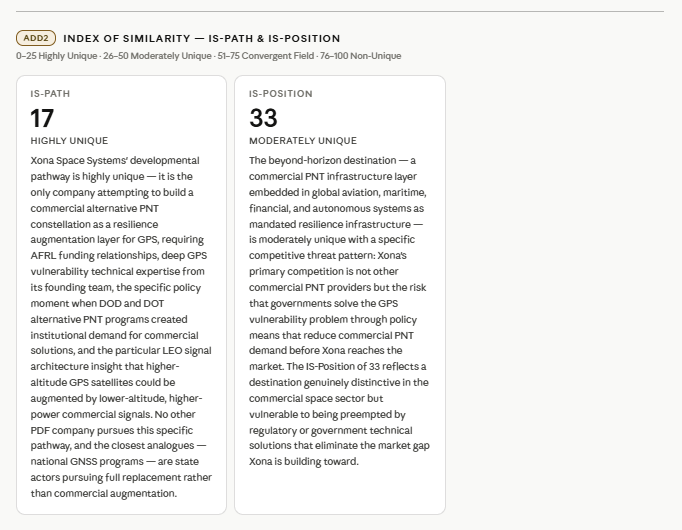
ADD2 — Index of Similarity — IS-Path & IS-Position
0–25 Highly Unique · 26–50 Moderately Unique · 51–75 Convergent Field · 76–100 Non-Unique
IS-Path — 17 — Highly Unique
Xona Space Systems’ developmental pathway is highly unique — it is the only company attempting to build a commercial alternative PNT constellation as a resilience augmentation layer for GPS, requiring AFRL funding relationships, deep GPS vulnerability technical expertise from its founding team, the specific policy moment when DOD and DOT alternative PNT programs created institutional demand for commercial solutions, and the particular LEO signal architecture insight that higher-altitude GPS satellites could be augmented by lower-altitude, higher-power commercial signals. No other PDF company pursues this specific pathway, and the closest analogues — national GNSS programs — are state actors pursuing full replacement rather than commercial augmentation.
IS-Position — 33 — Moderately Unique
The beyond-horizon destination — a commercial PNT infrastructure layer embedded in global aviation, maritime, financial, and autonomous systems as mandated resilience infrastructure — is moderately unique with a specific competitive threat pattern: Xona’s primary competition is not other commercial PNT providers but the risk that governments solve the GPS vulnerability problem through policy means that reduce commercial PNT demand before Xona reaches the market. The IS-Position of 33 reflects a destination genuinely distinctive in the commercial space sector but vulnerable to being preempted by regulatory or government technical solutions that eliminate the market gap Xona is building toward.
ADD3 — Social Alignment Index — IA
0–25 High Friction · 26–50 Moderate Friction · 51–75 Moderate Alignment · 76–100 High Alignment
IA · Social Alignment — 63 — Moderate Alignment
Xona benefits from moderate-to-strong social alignment driven by convergence of powerful structural trends. Key alignment drivers: GPS vulnerability is increasingly recognized as a systemic national security risk across the US, UK, EU, and allied nations, creating rare combination of defense, regulatory, and commercial demand that is both bipartisan and international; the growth of autonomous systems creates timing and positioning demand intensity that exceeds GPS’s design specifications, generating organic commercial pull independent of government mandate; and increasing frequency of GPS jamming events near conflict zones is making the public legitimacy argument for GPS resilience more accessible than ever. Key friction points: the ‘GPS is free’ mental model requires regulatory mandate rather than voluntary adoption to overcome at commercial scale; the dual-use nature of high-power PNT signals creates export control complexity for international expansion; and dependence on regulatory timelines outside Xona’s control means the commercialization window is uncertain despite the technical and strategic case being clear. The IA of 63 reflects a company strongly aligned with dominant societal trajectories but whose commercialization depends on regulatory catalysts moving in the right direction at uncertain speed.