
Beyond Horizon Analysis: BioOrbit — The Fermentation Moment for Space Manufacturing of Drugs
A BH Weekly Analysis: Orbital crystallisation of biologics could make hospital-only drugs injectable at home


Join Beyond Horizon for one original intelligence report each week exploring where frontier space companies are heading—and why.
Text-only version:
Beyond Horizon Analysis: BioOrbit — The Fermentation Moment for Space Manufacturing of Drugs
A BH Weekly Analysis: Orbital crystallisation of biologics could make hospital-only drugs injectable at home
Immediate · 0–2y | Horizon · 3–5y | Beyond · 10y+
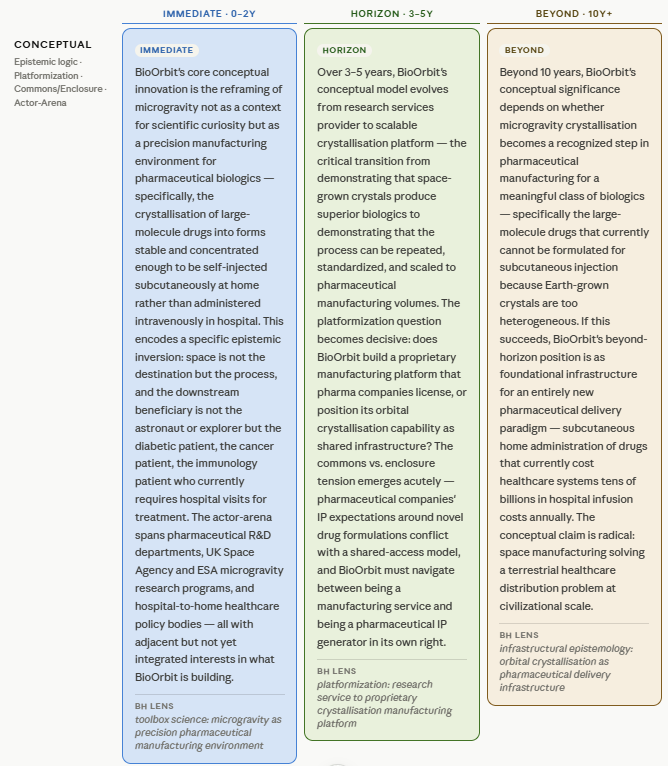
CONCEPTUAL — Epistemic logic · Platformization · Commons/Enclosure · Actor-Arena
Immediate
BioOrbit’s core conceptual innovation is the reframing of microgravity not as a context for scientific curiosity but as a precision manufacturing environment for pharmaceutical biologics — specifically, the crystallisation of large-molecule drugs into forms stable and concentrated enough to be self-injected subcutaneously at home rather than administered intravenously in hospital. This encodes a specific epistemic inversion: space is not the destination but the process, and the downstream beneficiary is not the astronaut or explorer but the diabetic patient, the cancer patient, the immunology patient who currently requires hospital visits for treatment. The actor-arena spans pharmaceutical R&D departments, UK Space Agency and ESA microgravity research programs, and hospital-to-home healthcare policy bodies — all with adjacent but not yet integrated interests in what BioOrbit is building.
BH lens: toolbox science — microgravity as precision pharmaceutical manufacturing environment
Horizon
Over 3–5 years, BioOrbit’s conceptual model evolves from research services provider to scalable crystallisation platform — the critical transition from demonstrating that space-grown crystals produce superior biologics to demonstrating that the process can be repeated, standardized, and scaled to pharmaceutical manufacturing volumes. The platformization question becomes decisive: does BioOrbit build a proprietary manufacturing platform that pharma companies license, or position its orbital crystallisation capability as shared infrastructure? The commons vs. enclosure tension emerges acutely — pharmaceutical companies’ IP expectations around novel drug formulations conflict with a shared-access model, and BioOrbit must navigate between being a manufacturing service and being a pharmaceutical IP generator in its own right.
BH lens: platformization — research service to proprietary crystallisation manufacturing platform
Beyond
Beyond 10 years, BioOrbit’s conceptual significance depends on whether microgravity crystallisation becomes a recognized step in pharmaceutical manufacturing for a meaningful class of biologics — specifically the large-molecule drugs that currently cannot be formulated for subcutaneous injection because Earth-grown crystals are too heterogeneous. If this succeeds, BioOrbit’s beyond-horizon position is as foundational infrastructure for an entirely new pharmaceutical delivery paradigm — subcutaneous home administration of drugs that currently cost healthcare systems tens of billions in hospital infusion costs annually. The conceptual claim is radical: space manufacturing solving a terrestrial healthcare distribution problem at civilizational scale.
BH lens: infrastructural epistemology — orbital crystallisation as pharmaceutical delivery infrastructure
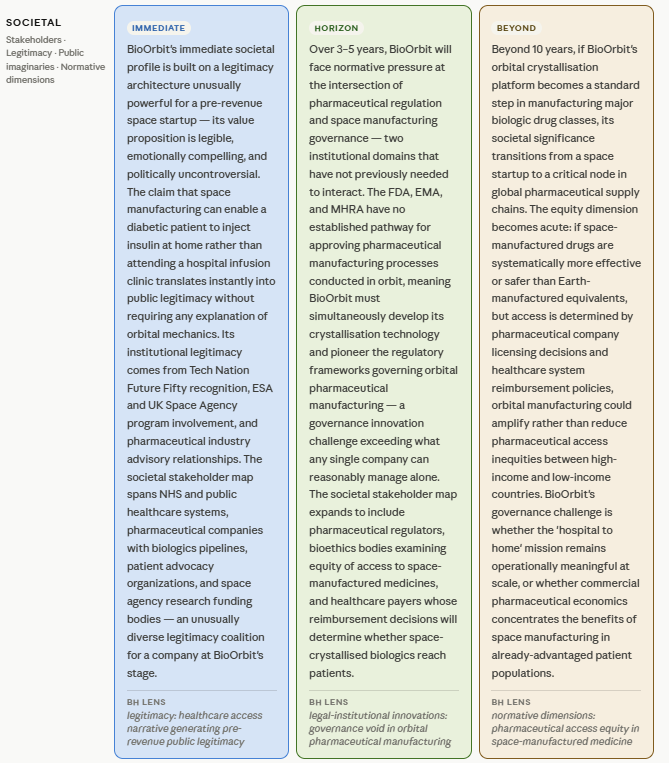
SOCIETAL — Stakeholders · Legitimacy · Public imaginaries · Normative dimensions
Immediate
BioOrbit’s immediate societal profile is built on a legitimacy architecture unusually powerful for a pre-revenue space startup — its value proposition is legible, emotionally compelling, and politically uncontroversial. The claim that space manufacturing can enable a diabetic patient to inject insulin at home rather than attending a hospital infusion clinic translates instantly into public legitimacy without requiring any explanation of orbital mechanics. Its institutional legitimacy comes from Tech Nation Future Fifty recognition, ESA and UK Space Agency program involvement, and pharmaceutical industry advisory relationships. The societal stakeholder map spans NHS and public healthcare systems, pharmaceutical companies with biologics pipelines, patient advocacy organizations, and space agency research funding bodies — an unusually diverse legitimacy coalition for a company at BioOrbit’s stage.
BH lens: legitimacy — healthcare access narrative generating pre-revenue public legitimacy
Horizon
Over 3–5 years, BioOrbit will face normative pressure at the intersection of pharmaceutical regulation and space manufacturing governance — two institutional domains that have not previously needed to interact. The FDA, EMA, and MHRA have no established pathway for approving pharmaceutical manufacturing processes conducted in orbit, meaning BioOrbit must simultaneously develop its crystallisation technology and pioneer the regulatory frameworks governing orbital pharmaceutical manufacturing — a governance innovation challenge exceeding what any single company can reasonably manage alone. The societal stakeholder map expands to include pharmaceutical regulators, bioethics bodies examining equity of access to space-manufactured medicines, and healthcare payers whose reimbursement decisions will determine whether space-crystallised biologics reach patients.
BH lens: legal-institutional innovations — governance void in orbital pharmaceutical manufacturing
Beyond
Beyond 10 years, if BioOrbit’s orbital crystallisation platform becomes a standard step in manufacturing major biologic drug classes, its societal significance transitions from a space startup to a critical node in global pharmaceutical supply chains. The equity dimension becomes acute: if space-manufactured drugs are systematically more effective or safer than Earth-manufactured equivalents, but access is determined by pharmaceutical company licensing decisions and healthcare system reimbursement policies, orbital manufacturing could amplify rather than reduce pharmaceutical access inequities between high-income and low-income countries. BioOrbit’s governance challenge is whether the ‘hospital to home’ mission remains operationally meaningful at scale, or whether commercial pharmaceutical economics concentrates the benefits of space manufacturing in already-advantaged patient populations.
BH lens: normative dimensions — pharmaceutical access equity in space-manufactured medicine
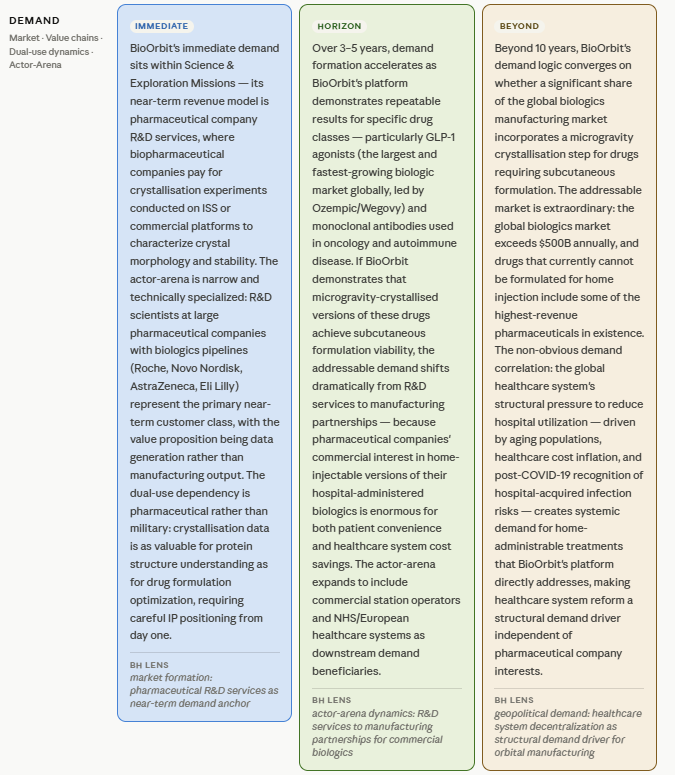
DEMAND — Market · Value chains · Dual-use dynamics · Actor-Arena
Immediate
BioOrbit’s immediate demand sits within Science & Exploration Missions — its near-term revenue model is pharmaceutical company R&D services, where biopharmaceutical companies pay for crystallisation experiments conducted on ISS or commercial platforms to characterize crystal morphology and stability. The actor-arena is narrow and technically specialized: R&D scientists at large pharmaceutical companies with biologics pipelines (Roche, Novo Nordisk, AstraZeneca, Eli Lilly) represent the primary near-term customer class, with the value proposition being data generation rather than manufacturing output. The dual-use dependency is pharmaceutical rather than military: crystallisation data is as valuable for protein structure understanding as for drug formulation optimization, requiring careful IP positioning from day one.
BH lens: market formation — pharmaceutical R&D services as near-term demand anchor
Horizon
Over 3–5 years, demand formation accelerates as BioOrbit’s platform demonstrates repeatable results for specific drug classes — particularly GLP-1 agonists (the largest and fastest-growing biologic market globally, led by Ozempic/Wegovy) and monoclonal antibodies used in oncology and autoimmune disease. If BioOrbit demonstrates that microgravity-crystallised versions of these drugs achieve subcutaneous formulation viability, the addressable demand shifts dramatically from R&D services to manufacturing partnerships — because pharmaceutical companies’ commercial interest in home-injectable versions of their hospital-administered biologics is enormous for both patient convenience and healthcare system cost savings. The actor-arena expands to include commercial station operators and NHS/European healthcare systems as downstream demand beneficiaries.
BH lens: actor-arena dynamics — R&D services to manufacturing partnerships for commercial biologics
Beyond
Beyond 10 years, BioOrbit’s demand logic converges on whether a significant share of the global biologics manufacturing market incorporates a microgravity crystallisation step for drugs requiring subcutaneous formulation. The addressable market is extraordinary: the global biologics market exceeds $500B annually, and drugs that currently cannot be formulated for home injection include some of the highest-revenue pharmaceuticals in existence. The non-obvious demand correlation: the global healthcare system’s structural pressure to reduce hospital utilization — driven by aging populations, healthcare cost inflation, and post-COVID-19 recognition of hospital-acquired infection risks — creates systemic demand for home-administrable treatments that BioOrbit’s platform directly addresses, making healthcare system reform a structural demand driver independent of pharmaceutical company interests.
BH lens: geopolitical demand — healthcare system decentralization as structural demand driver for orbital manufacturing
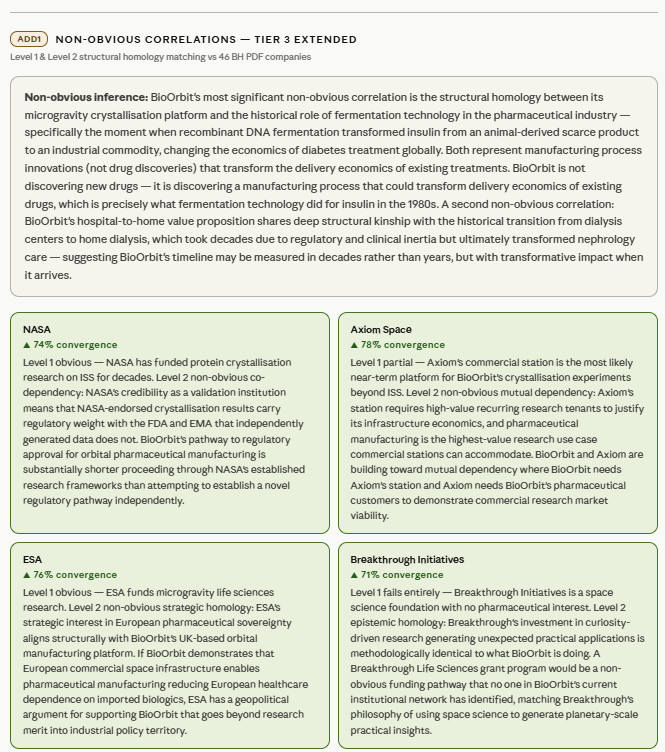
ADD1 — Non-Obvious Correlations — Tier 3 Extended
Level 1 & Level 2 structural homology matching vs 46 BH PDF companies
Non-obvious inference: BioOrbit’s most significant non-obvious correlation is the structural homology between its microgravity crystallisation platform and the historical role of fermentation technology in the pharmaceutical industry — specifically the moment when recombinant DNA fermentation transformed insulin from an animal-derived scarce product to an industrial commodity, changing the economics of diabetes treatment globally. Both represent manufacturing process innovations (not drug discoveries) that transform the delivery economics of existing treatments. BioOrbit is not discovering new drugs — it is discovering a manufacturing process that could transform delivery economics of existing drugs, which is precisely what fermentation technology did for insulin in the 1980s. A second non-obvious correlation: BioOrbit’s hospital-to-home value proposition shares deep structural kinship with the historical transition from dialysis centers to home dialysis, which took decades due to regulatory and clinical inertia but ultimately transformed nephrology care — suggesting BioOrbit’s timeline may be measured in decades rather than years, but with transformative impact when it arrives.
NASA — ▲ 74% convergence
Level 1 obvious — NASA has funded protein crystallisation research on ISS for decades. Level 2 non-obvious co-dependency: NASA’s credibility as a validation institution means that NASA-endorsed crystallisation results carry regulatory weight with the FDA and EMA that independently generated data does not. BioOrbit’s pathway to regulatory approval for orbital pharmaceutical manufacturing is substantially shorter proceeding through NASA’s established research frameworks than attempting to establish a novel regulatory pathway independently.
Axiom Space — ▲ 78% convergence
Level 1 partial — Axiom’s commercial station is the most likely near-term platform for BioOrbit’s crystallisation experiments beyond ISS. Level 2 non-obvious mutual dependency: Axiom’s station requires high-value recurring research tenants to justify its infrastructure economics, and pharmaceutical manufacturing is the highest-value research use case commercial stations can accommodate. BioOrbit and Axiom are building toward mutual dependency where BioOrbit needs Axiom’s station and Axiom needs BioOrbit’s pharmaceutical customers to demonstrate commercial research market viability.
ESA — ▲ 76% convergence
Level 1 obvious — ESA funds microgravity life sciences research. Level 2 non-obvious strategic homology: ESA’s strategic interest in European pharmaceutical sovereignty aligns structurally with BioOrbit’s UK-based orbital manufacturing platform. If BioOrbit demonstrates that European commercial space infrastructure enables pharmaceutical manufacturing reducing European healthcare dependence on imported biologics, ESA has a geopolitical argument for supporting BioOrbit that goes beyond research merit into industrial policy territory.
Breakthrough Initiatives — ▲ 71% convergence
Level 1 fails entirely — Breakthrough Initiatives is a space science foundation with no pharmaceutical interest. Level 2 epistemic homology: Breakthrough’s investment in curiosity-driven research generating unexpected practical applications is methodologically identical to what BioOrbit is doing. A Breakthrough Life Sciences grant program would be a non-obvious funding pathway that no one in BioOrbit’s current institutional network has identified, matching Breakthrough’s philosophy of using space science to generate planetary-scale practical insights.
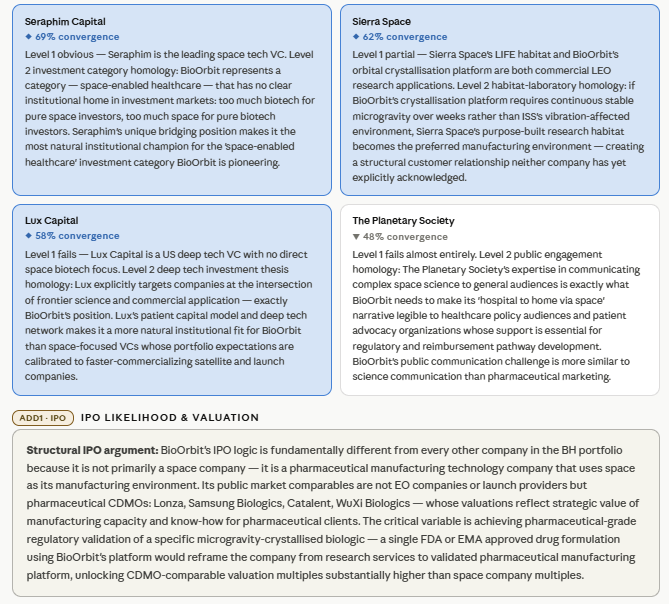
Seraphim Capital — ◆ 69% convergence
Level 1 obvious — Seraphim is the leading space tech VC. Level 2 investment category homology: BioOrbit represents a category — space-enabled healthcare — that has no clear institutional home in investment markets: too much biotech for pure space investors, too much space for pure biotech investors. Seraphim’s unique bridging position makes it the most natural institutional champion for the ‘space-enabled healthcare’ investment category BioOrbit is pioneering.
Sierra Space — ◆ 62% convergence
Level 1 partial — Sierra Space’s LIFE habitat and BioOrbit’s orbital crystallisation platform are both commercial LEO research applications. Level 2 habitat-laboratory homology: if BioOrbit’s crystallisation platform requires continuous stable microgravity over weeks rather than ISS’s vibration-affected environment, Sierra Space’s purpose-built research habitat becomes the preferred manufacturing environment — creating a structural customer relationship neither company has yet explicitly acknowledged.
Lux Capital — ◆ 58% convergence
Level 1 fails — Lux Capital is a US deep tech VC with no direct space biotech focus. Level 2 deep tech investment thesis homology: Lux explicitly targets companies at the intersection of frontier science and commercial application — exactly BioOrbit’s position. Lux’s patient capital model and deep tech network makes it a more natural institutional fit for BioOrbit than space-focused VCs whose portfolio expectations are calibrated to faster-commercializing satellite and launch companies.
The Planetary Society — ▼ 48% convergence
Level 1 fails almost entirely. Level 2 public engagement homology: The Planetary Society’s expertise in communicating complex space science to general audiences is exactly what BioOrbit needs to make its ‘hospital to home via space’ narrative legible to healthcare policy audiences and patient advocacy organizations whose support is essential for regulatory and reimbursement pathway development. BioOrbit’s public communication challenge is more similar to science communication than pharmaceutical marketing.
ADD1 · IPO — IPO Likelihood & Valuation
Structural IPO argument: BioOrbit’s IPO logic is fundamentally different from every other company in the BH portfolio because it is not primarily a space company — it is a pharmaceutical manufacturing technology company that uses space as its manufacturing environment. Its public market comparables are not EO companies or launch providers but pharmaceutical CDMOs: Lonza, Samsung Biologics, Catalent, WuXi Biologics — whose valuations reflect strategic value of manufacturing capacity and know-how for pharmaceutical clients. The critical variable is achieving pharmaceutical-grade regulatory validation of a specific microgravity-crystallised biologic — a single FDA or EMA approved drug formulation using BioOrbit’s platform would reframe the company from research services to validated pharmaceutical manufacturing platform, unlocking CDMO-comparable valuation multiples substantially higher than space company multiples.
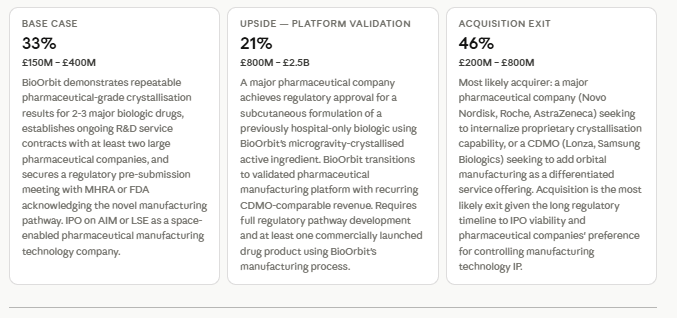
Base Case — 33% — £150M – £400M
BioOrbit demonstrates repeatable pharmaceutical-grade crystallisation results for 2-3 major biologic drugs, establishes ongoing R&D service contracts with at least two large pharmaceutical companies, and secures a regulatory pre-submission meeting with MHRA or FDA acknowledging the novel manufacturing pathway. IPO on AIM or LSE as a space-enabled pharmaceutical manufacturing technology company.
Upside — Platform Validation — 21% — £800M – £2.5B
A major pharmaceutical company achieves regulatory approval for a subcutaneous formulation of a previously hospital-only biologic using BioOrbit’s microgravity-crystallised active ingredient. BioOrbit transitions to validated pharmaceutical manufacturing platform with recurring CDMO-comparable revenue. Requires full regulatory pathway development and at least one commercially launched drug product using BioOrbit’s manufacturing process.
Acquisition Exit — 46% — £200M – £800M
Most likely acquirer: a major pharmaceutical company (Novo Nordisk, Roche, AstraZeneca) seeking to internalize proprietary crystallisation capability, or a CDMO (Lonza, Samsung Biologics) seeking to add orbital manufacturing as a differentiated service offering. Acquisition is the most likely exit given the long regulatory timeline to IPO viability and pharmaceutical companies’ preference for controlling manufacturing technology IP.
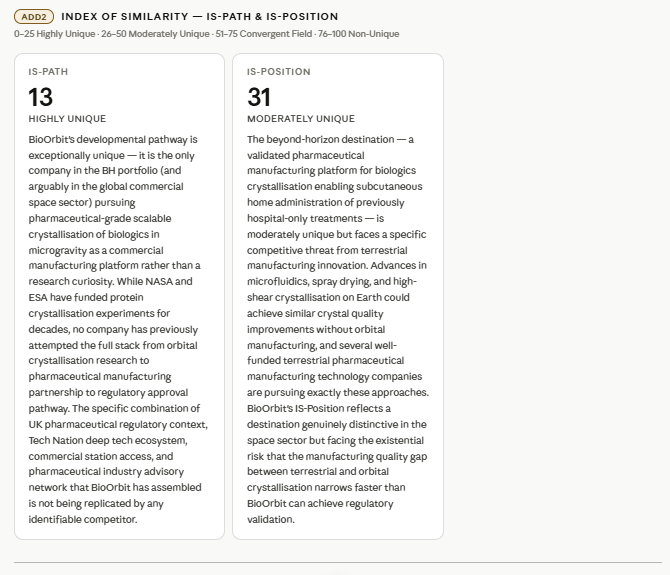
ADD2 — Index of Similarity — IS-Path & IS-Position
0–25 Highly Unique · 26–50 Moderately Unique · 51–75 Convergent Field · 76–100 Non-Unique
IS-Path — 13 — Highly Unique
BioOrbit’s developmental pathway is exceptionally unique — it is the only company in the BH portfolio (and arguably in the global commercial space sector) pursuing pharmaceutical-grade scalable crystallisation of biologics in microgravity as a commercial manufacturing platform rather than a research curiosity. While NASA and ESA have funded protein crystallisation experiments for decades, no company has previously attempted the full stack from orbital crystallisation research to pharmaceutical manufacturing partnership to regulatory approval pathway. The specific combination of UK pharmaceutical regulatory context, Tech Nation deep tech ecosystem, commercial station access, and pharmaceutical industry advisory network that BioOrbit has assembled is not being replicated by any identifiable competitor.
IS-Position — 31 — Moderately Unique
The beyond-horizon destination — a validated pharmaceutical manufacturing platform for biologics crystallisation enabling subcutaneous home administration of previously hospital-only treatments — is moderately unique but faces a specific competitive threat from terrestrial manufacturing innovation. Advances in microfluidics, spray drying, and high-shear crystallisation on Earth could achieve similar crystal quality improvements without orbital manufacturing, and several well-funded terrestrial pharmaceutical manufacturing technology companies are pursuing exactly these approaches. BioOrbit’s IS-Position reflects a destination genuinely distinctive in the space sector but facing the existential risk that the manufacturing quality gap between terrestrial and orbital crystallisation narrows faster than BioOrbit can achieve regulatory validation.
ADD3 — Social Alignment Index — IA
0–25 High Friction · 26–50 Moderate Friction · 51–75 Moderate Alignment · 76–100 High Alignment
IA · Social Alignment — 59 — Moderate Alignment
BioOrbit faces moderate social alignment with a specific friction pattern shaped by the intersection of healthcare system politics and space manufacturing novelty. Key alignment drivers: aging populations across OECD countries generate sustained political pressure to reduce hospital utilization costs; the COVID-19 pandemic demonstrated vulnerability of hospital-dependent healthcare delivery and created lasting political will for home-based care alternatives; and the GLP-1 biologic market’s extraordinary growth has created pharmaceutical industry incentives to develop subcutaneous formulations at unprecedented scale. Key friction points: pharmaceutical regulatory agencies have no established pathway for approving orbital manufacturing processes, potentially adding a decade to commercialization; healthcare payers’ willingness to reimburse space-manufactured medicines at premium prices is uncertain and politically sensitive; and the equity dimension — space-manufactured drugs available only in wealthy healthcare systems — is a legitimate normative objection BioOrbit’s public communications have not yet addressed. The IA of 59 reflects a company whose healthcare mission is strongly aligned with dominant societal trajectories in healthcare delivery reform, but whose commercialization runs through regulatory and reimbursement institutions structurally slow to accommodate genuinely novel manufacturing approaches.